Table of Contents
Digital Two-Way Radio
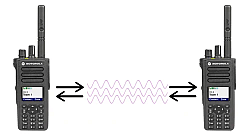
A two-way digital radio is a modern, voice-and-data communication device that converts audio into digital packets for transmission, offering clearer voice quality, longer battery life, and greater security compared to analog radios. These radios operate over, often requiring no subscription fees, enabling instant push-to-talk (PTT) communication directly between devices. (1)
Digital Modes
Two-way digital radio modes, such as DMR, P25, D-STAR, and NXDN, use digitized voice and data to improve audio clarity, increase capacity, and enable features like GPS and text messaging. These modes operate via TDMA or FDMA protocols, allowing for more efficient spectrum use and often providing clearer, quieter communication than analog systems.
A Few Common Modes Used in Amateur Radio…
C4FM
Continuous Four-Level Frequency Modulation - A digital voice and data mode used primarily in Yaesu System Fusion amateur radio equipment. It utilizes FDMA (Frequency Division Multiple Access) to deliver high-quality audio and data transmission within a 12.5 kHz bandwidth, often featuring automatic mode selection between digital and analog. (2)
DMR
Digital Mobile Radio - A widely used standard for professional and amateur radio, utilizing two-slot TDMA (Time Division Multiple Access) to provide two voice channels on a single 12.5 kHz channel.
D-STAR
Digital Smart Technology for Amateur Radio - An amateur radio-specific mode developed by JARL (Japan Amateur Radio League) that offers internet linking capabilities and voice/data capability.
NXDN
NXDN: A digital protocol designed for commercial, business, and industrial use, offering 6.25 kHz narrowband efficiency.
P25
Designed for public safety and emergency services, providing secure, reliable digital communication.
Digital Voice Networks
A system that digitizes voice signals and transmits them over radio frequencies, often linking local repeaters or hotspots to the internet for worldwide communication. These networks allow for clearer audio, lower-power communication, and additional data capabilities, such as transmitting call signs or location data.
Brandmeister
The BrandMeister network is a large, decentralized, worldwide amateur radio digital voice network, primarily used for DMR (Digital Mobile Radio). It connects repeaters and personal hotspots via the internet, allowing users to communicate globally using talk groups. It is known for supporting multiple radio vendors and offering advanced features like SMS gateways, APRS positioning, and dynamic talk group allocation.
WIRES-X
WIRES (Wide-coverage Internet Repeater Enhancement System) is an Internet communication system which expands the range of amateur radio communication. For WIRES-X, an amateur node station connecting to the Internet is used as the access point and connects the wireless communication to the Internet. Users’ stations can communicate with other amateur stations all over the world using a node within the radio wave range.
XLX
The XLX network is a multi-protocol digital reflector system used by amateur radio operators to link different digital voice modes together, primarily supporting D-STAR, DMR, and Yaesu System Fusion (YSF).
